择天记
A mountain standing for millennia finds new ways to tell its story online_我的网站

A | JACKSON, Miss. -- One of the people being sued by the Mississippi Department of Human Services over allegations of misspending welfare money has filed a separate lawsuit against Gov. Tate Reeves, saying the Republican is trying to protect political allies including a former governor.Austin Garrett Smith filed the suit Wednesday and described himself in court papers as “politically powerless.” Smith's suit says Reeves should sue Republican former Gov. Phil Bryant, who was in office when prosecutors say money that was supposed to help some of the poorest people in the U.S. was instead spent on projects pushed by wealthy and well connected people.“Reeves has actively shifted the focus of the MDHS lawsuit away from Bryant, despite overwhelming evidence of Bryant's involvement,” Smith's attorney, Jim Waide, wrote.Reeves press secretary Shelby Wilcher said in response to questions about Smith's lawsuit: “The State of Mississippi is fighting to claw back every single dollar that was misspent in the scandal that occurred before Governor Reeves assumed this office.”The Department of Human Services filed a lawsuit in 2022 against more than two dozen businesses or people, including Smith and retired NFL quarterback Brett Favre. The ongoing suit seeks to recover more than $20 million of the roughly $77 million in welfare money that the state auditor said had been misspent between 2016 and 2019, during Bryant's second term as governor.Auditor Shad White said the misspending included $5 million for one of Favre's pet projects, a volleyball arena at the University of Southern Mississippi. Smith is a nephew of former Mississippi Department of Human Services executive director John Davis.The state's lawsuit says Smith received more than $426,000 of money from the Temporary Assistance for Needy Families Program from 2017 to 2019 for purposes not allowed by the program. It says Smith was paid from “under the guise” of providing services for two nonprofit groups whose leaders had close ties to Davis and Bryant.Smith's lawsuit says that several defendants in the state's lawsuit, including Smith, have “little or no” property they could use to pay any judgment against them.Smith's lawsuit also says Reeves has improperly hired private attorneys to represent the Department of Human Services when that legal work should be done by the state attorney general's office.“Reeves has controlled the MDHS suit in order to advance his own political interests and protect his political allies,” Waide wrote.Reeves is seeking a second term in the Nov. 7 election. The Democratic nominee for governor, Brandon Presley, said Reeves is tainted by the welfare misspending that occurred when Reeves was lieutenant governor and had power to oversee how the Department of Human Services was operating. Presley noted that Reeves had received campaign contributions from central figures in the scandal and that the governor's brother, Todd Reeves, had sent text message to the state auditor asking White to praise Favre.“Tate Reeves is too ethically compromised to lead this investigation,” Presley said Wednesday.Reeves campaign spokesperson Clifton Carroll said in a statement: “It's no surprise that some of the defendants who are being sued by the Reeves administration are unhappy because he is aggressively pursuing this case.”。

B |

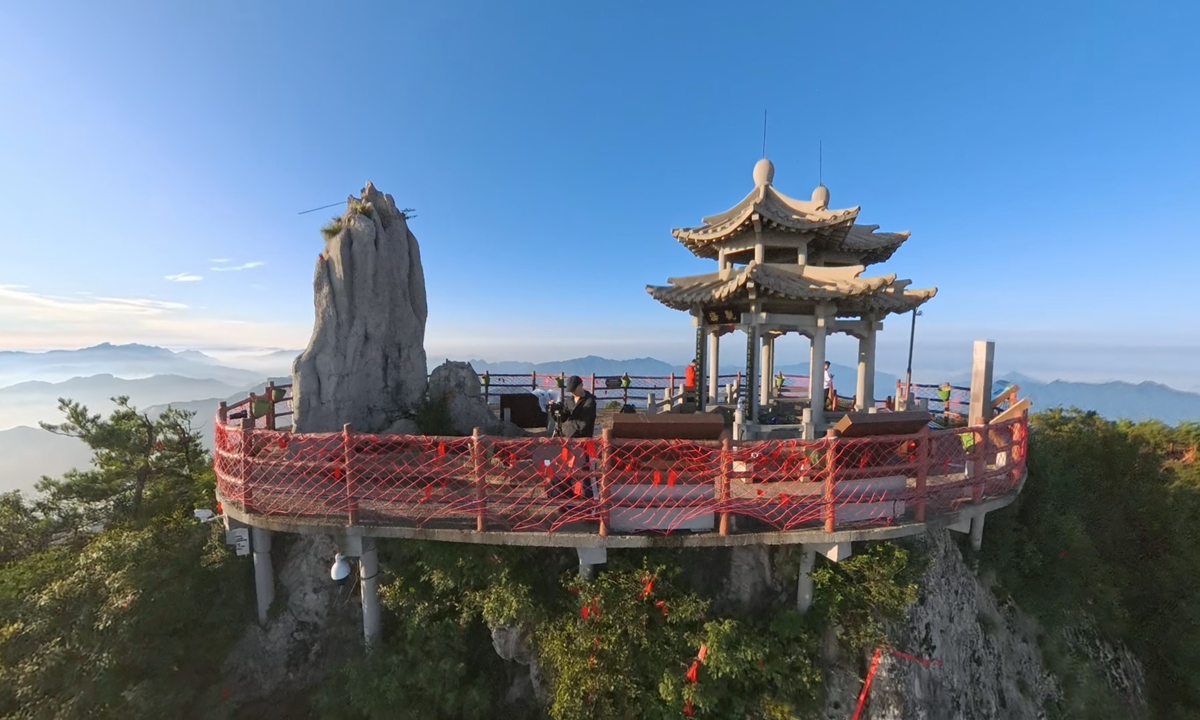
A sea of clouds rolls across Laojun Mountain in Luoyang, Central China's Henan Province, with golden-roofed temples emerging through the mist, on July 6, 2026. Photo: VCGFor 30 days, Li Sichen got up before sunrise on top of Laojun Mountain, camera in hand, chasing clouds across the peaks. Some mornings, the sea of clouds rolled in before breakfast; on others, he had to keep moving, checking one viewpoint after another in search of a patch of mist worth filming. By the time he got back to the foot of the mountain, the 22-year-old had spent a month watching the same landscape change by the hour - all for a job that had first caught the internet's attention for one simple reason: 60,000 yuan ($8,900) a month to "watch clouds."
It all began with Laojun Mountain's spectacular summer cloud season. In a recruitment notice issued in July, operator of the scenic spot said July and August offer some of the best chances to see seas of clouds there, and it wanted someone to stay on the mountain and record how the spectacle changed from day to day. The unusual job posting unexpectedly drew over 3,500 entries in about a week, with Li eventually emerging as the mountain's first "cloud sea observer."
Located in Luanchuan county of Luoyang, Central China's Henan Province, Laojun Mountain rises to 2,217 meters and is known for its dramatic peaks, seas of clouds and long history of Taoist culture, according to the mountain's official website.
But how does it feel like to work on top of the mountain, far away from online shopping, food delivery and party with friends?
An unconventional way of seeing "My days on the mountain quickly settled into a rhythm shaped partly by the clouds, and partly by the cafeteria," Li told the Global Times. He usually got up around 5 am to shoot the sunrise and clouds, had an early lunch as the cafeteria opens at 11 am, spent the afternoon exploring around the mountain, then rushed to cafeteria for dinner before heading back to the observation spots for sunset. The day often ended with editing footage until close to midnight.
"Sometimes there is nothing in front of you from one viewpoint, but after walking a little farther and changing the angle, a small sea of clouds jumps in front of my eyes."
Professional photographers usually seek higher vantage points for better views of seas of clouds, while Li sometimes headed down toward the mountainside. "That was something I really hadn't expected," Zhang Pengyuan, a manager at Laojun Mountain, told the Global Times.
"This was exactly why the scenic spot wanted eyes from outside to find the beauty of the mountain through a different angle," Zhang said.
What set Li apart, Zhang joked, was precisely that he was "not professional." Unable to calculate cloud heights or predict the perfect shooting conditions from weather forecast, Li relied on the simplest method: going out again and again to see what had changed. That sometimes led to compositions the scenic spot's own photographers had never considered. "What he recorded was closer to what an ordinary visitor could actually see," Zhang said.
Li had arrived on the mountain with little professional photography experience. Media reports said that before taking the job, he was not yet proficient with a drone, and his previous videos usually drew only a few hundred or a few thousand views. However, that changed almost overnight when his application video took off, eventually drawing tens of thousands of likes and helping him stand out from more than 3,500 applicants.
The "cloud observer" Li Sichen adjusts filming equipment at an attraction point on Laojun Mountain. Photo: Courtesy of Li Sichen
From visitors to storytellers Beyond Laojun Mountain, scenic spots across China have increasingly been inviting young people to take part in content creation, event planning and tourism promotion, often through unconventional jobs tailored to the language and habits of social media.
According to Southern Metropolis Daily, Shennong Valley National Forest Park in Central China's Hunan Province recently recruited 10 "wild men" to dress in animal costumes and interact with visitors in the forest.
The Dixin Valley Scenic Area in Hubei Province also drew more than 3,000 applicants for 12 summer trainee positions to play as NPCs, produce creative content, and work as photographer and tour guide for 10 days.
The idea goes beyond novelty. Scenic spots are increasingly turning to young creators who understand short videos, online trends and the interests of their peers. A tourism short-video contest in Jinhua, East China's Zhejiang Province held in 2025 featured university students presenting the city through vlogs, traditional-style costume transformations and AI-generated art - part of a broader effort to let young people help shape how destinations are seen and experienced.
Young travelers are increasingly drawn to experiences that are immersive, participatory and easy to share, reflecting a broader shift in China's tourism market from "standardized sightseeing" toward more personalized experiences, Zhang Lingyun, a professor and the executive editor-in-chief of the Tourism Tribune, told the Global Times.
As tourism offerings have expanded and competition has grown, travelers have more choices. Changing consumer preferences in China mean many young people now look beyond simply "seeing the beauty" to experiences that feel distinctive, personal and worth sharing on social media.
The internet and social media have accelerated this shift, Zhang said, adding that as "digital natives," Chinese young people are becoming increasingly fluent in short videos, social platforms and online interaction. By bringing young people directly into content production, scenic spots can move beyond simply guessing what tourists want through surveys, and learn from what they actually create and share.
Initiatives such as the "cloud sea observer" can help destinations rediscover themselves through a visitor's eyes while reaching younger audiences more effectively. The goal, Zhang noted, remains the same: better meeting tourists' needs, even as the tools, channels and participants have changed, he said.
On his final morning on Laojun Mountain, Li got up early once again to watch the sunrise. But this time, he lowered the camera.
"That was when I suddenly realized how beautiful the mountain really was," Li said. After 30 days of chasing clouds, searching for angles and turning each day into footage to share with other young Chinese in the online community, he was finally able to simply look.
When Li was really enjoying the last moments on the mountain, he - just like the line from comedy The Secret Life of Walter Mitty - "didn't like to have the distraction of the camera. Just wanted to stay in it."
。
Current article:http://ikj6x.linlangdouwaqiexusan.bond/news/20260826_183.html
Published on:17:04:33


